Showing posts with label William Hunter. Show all posts

Monday, 10 July 2023

The Anatomist and the Irish Giant


Visitors to London's Leicester Square today find it a place of entertainment and perhaps a bit of naughtiness. Eating, drinking, theater, and gambling are on offer. Few of the visitors are aware that once the square was home to a major center for teaching surgery and anatomy. Untold numbers of dissections took place there, of both human and animal bodies. 

During the late 18th century, Leicester Square was the location of the anatomy school of the renowned (and sometimes reviled) surgeon John Hunter. His bust once graced the central area of the square but was removed as part of a renovation in 2012. It is unlikely that many visitors ever gave it more than a passing glance anyway. They are usually there for other reasons than absorbing a bit of history.


The younger brother of anatomist William Hunter, John learned his trade working for William. The business included the art of body snatching, the main source of human corpses for dissection until the 1830's. Eventually, the brothers fell out and John went his own way.

After serving as an army surgeon for several years, John set up his own anatomy school, which eventually settled at the Square. The building, which also contained his house and an extensive anatomical museum, now houses a pub. (below)


Directly across the square lay the house of his friend Joshua Reynolds, a portrait painter of the wealthy who had a strong interest in anatomy. Reynolds' house is now a bar. But don't knock Progress.

Hunter dissected every type of human or animal he could lay his hands on. His subjects included the famous Irish Giant, Charles Byrne or O'Brien, pictured at the top of the post in a print by Thomas Rowlandson from 1785. 

Hunter acquired the giant's body against the deceased's wishes by bribing the man who had it, allegedly for the then enormous sum of 500 pounds. Hilary Mantel wrote a novel about Hunter's pursuit of the Irishman's corpse, The Giant, O'Brien (1998).

In the painting of Hunter below, one can see part of the giant's skeleton, at top right. The painting today is on display at St. George's Hospital in Tooting. Hunter was chief surgeon at St. George's when it was located near Hyde Park. Today the hospital boasts one of the top cardiology units in the UK. I had the good fortune to benefit from it a couple of years ago. 

Ironically, Hunter himself died of a heart attack in 1793. It happened during a heated argument with the governors of St. George's Hospital. It may have been a burst aneurysm. 


Animals of all kinds, lower as well as higher, went under John Hunter's dissecting knives. He maintained a large menagerie at his suburban house at Earl's Court, including kangaroos, giraffes, and leopards. [Images: Hunter's house at Earl's Court.]


Hunter's huge anatomical collection, or what survives of it, now resides in the Hunterian Museum, at the Royal College of Surgeons, Lincoln's Inn Fields. Among the exhibits is the skeleton of the Irish Giant. It's fascinating stuff, but definitely not for the squeamish. [Image 1: Part of the Hunterian Collection Image 2: The skeleton of the giant]


In 1771, Hunter married Anne Home, a poet who wrote the lyrics to 14 of Franz Joseph Haydn's English songs. She and Haydn met after her husband's death. They became close friends. How close is a matter of speculation. 

Hunter left Anne in straitened financial circumstances. In 1799, she sold her husband's anatomical collection to the government for the then huge sum of £15,000. The government gave the collection to the Royal College of Surgeons. 

In 1776, Hunter became surgeon to King George III. In 1790, Prime Minister William Pitt appointed Hunter Surgeon General of the British Army. In the latter post he instituted reforms to insure that surgeons were recruited on the basis of ability rather than family connections.

Further Reading:

Wendy Moore, The Knife Man (London: Penguin, 2006)

Druin Burch, Digging up the Dead  (London: Vintage, 2008)

If you enjoyed this post and would like to become a follower of my blog, just click on the blue "FOLLOW" button on the right side of the first page. Below there you can also find my previous posts. Thanks! 


Thursday, 15 June 2023

Anatomy and Body Snatching in Georgian Britain: William Hunter


London's Soho district has long been notorious as a place where bodies are for sale. Living bodies. Less well known is its connection to the sale of dead bodies. If you walk along Shaftesbury Ave. to the Lyric Theatre, and turn onto Great Windmill Street, you will find this blue plaque on the side wall of the theatre:  


William Hunter (1718-1783), who once lived and worked here, was one of the most renowned (and often reviled) anatomists of the 18th century. He was born in Lanarkshire, Scotland. He studied medicine at Edinburgh University under William Cullen, then moved to London to train in anatomy and obstetrics at St. George's Hospital under William Smellie. Dissecting decaying bodies was indeed a smelly business, but the name was merely coincidental.  (Image: William Hunter, by Allan Ramsay)


Like all anatomists, Hunter needed dead bodies -- for his own research and for teaching anatomy. The number of legally available bodies, then restricted mainly to persons executed for murder, fell far short of the growing need. The number of anatomy schools, especially in London, was increasing, and with it, the demand for fresh corpses. 

For Hunter, the difficulty of obtaining bodies was compounded by the fact that much of his research was in obstetrics. His most famous work, The Anatomy of the Human Gravid Uterus (1774) involved the dissection of a lot of recently deceased pregnant women. 


Few if any of these bodies could have been obtained through normal legal channels. Executed murderers were not numerous enough, and in any case, pregnant women were rarely executed. They did, however, sometimes commit suicide out of a sense of shame or desperation. 

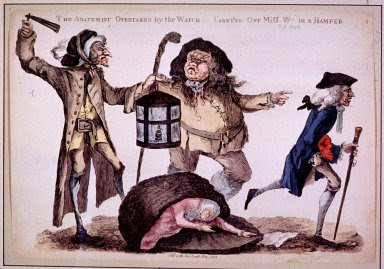
Most anatomical "subjects" had to be illegally "snatched," often from recent burials, sometimes before burial. In the cartoon at the top of this post, an anatomist, almost certainly Hunter, is shown fleeing after a watchman (at left) has discovered him with a woman's body. 

In 2010, Don Shelton argued that some of the women whose bodies Hunter acquired must have been murdered. Cases of people killing to acquire bodies to sell did occur, most famously that of Burke and Hare in Edinburgh in the 1820s, but there is no evidence that Hunter obtained corpses in this way.  

Anatomists and their students sometimes did body snatching themselves, but gangs of "resurrectionists" or "sack 'em up men" increasingly took over that task during the late 18th century. They took bodies from cemeteries, poorhouses, hospital morgues, and probably just found some lying in the streets or floating in rivers. 

Hunter's anatomy school in Great Windmill Street was a mecca for aspiring surgeons and physicians. A certificate of attendance at his courses was highly valued. Many of the most famous surgeons and anatomists of the next generation trained with William Hunter, or his younger brother John. [Image: Certificate of Attendance at William Hunter's lectures.]


Artists were highly interested in Hunter's work. His friends included famous painters and sculptors. In the painting below by Johan Zoffany, Hunter is pictured at the Royal Academy of Arts, next to Sir Joshua Reynolds (holding his ear trumpet in his arm).


Hunter's work and the source of his research material aroused much suspicion and derision. Cartoonists of the day sometimes made him their subject. The top one here shows Hunter with the mangled bodies of his "resurrected" subjects. The bottom image, by Thomas Rowlandson, shows a scene at Hunter's school. A man, possibly Hunter, is looking at a list of prices for bodies, male, female, and infant.


Further Reading:

Wendy Moore, The Knife Man (London: Penguin, 2006)

Don C. Shelton, "The Emperor's New Clothes," Journal of the Royal Society of Medicine, 2010: 103: 46-50


If you enjoyed this post and would like to become a follower of my blog, just click on the blue "FOLLOW" button on the right side of the first page. Below there you can also find my previous posts. Thanks! 

Wednesday, 29 September 2021

Pioneer of Natural Selection: William Charles Wells of Charleston

William Charles Wells is one of those historical figures who should be better known than he is. He was the first person to propose the theory of natural selection, decades before Charles Darwin and Alfred Russell Wallace. He was also the first to explain why dew forms on grass.

Wells was born in Charleston [then Charlestown], South Carolina in 1757 of Scottish immigrant parents. His father, Robert Wells, established a successful business as a printer, bookseller, and newspaper publisher in the town. [Image: Wells Shop, 71 Tradd Street]


When he was eleven, William's parents sent him to Scotland for education. Upon completion of his preparatory studies two years later, he attended Edinburgh University for a year. 

During his time in Scotland he made several lifelong friendships. One of his closest friends was David Hume, nephew of the famous philosopher of the same name. It is very likely he met the philosopher himself or at least became familiar with his ideas. 

Wells returned to Charleston in 1771 and started a medical apprenticeship under Dr. Alexander Garden, one of the most respected physicians in the town. Garden was also a respected naturalist for whom Linnaeus named the gardenia

In 1775, Wells left Charleston abruptly for London. The move was prompted by the beginning of the American War for Independence. He had refused to sign a document calling for armed resistance to the British government. His father, an ardent Loyalist, had already gone to London earlier that year.

The following year he enrolled again at the University of Edinburgh and studied medicine. In 1778 he returned to London and took a course of lectures under the famed anatomist William Hunter. He was also accepted as a surgeon's pupil at St. Bartholomew's Hospital. 

In 1779 he enlisted as a surgeon in a Scottish regiment in the Netherlands. According to his own account he resigned his commission due to ill-treatment by his commanding officer. He challenged the officer to a duel, but the officer refused to respond.

Wells then enrolled in the University of Leiden and prepared a dissertation, On Cold. He submitted it to Edinburgh in 1780 and received his M.D.

In May 1780, the British captured Charleston. Wells returned early in 1781 to manage his family's affairs there. For more than a year he wore many hats: he worked as a printer, bookseller, merchant, and a trustee for the properties of some of his father's friends. He also served in the Loyalist militia. 

When the British evacuated Charleston in December 1782, Wells removed to St. Augustine, where he established the first weekly newspaper in Florida, The East Florida Gazette. The paper did not last long, however. The British returned Florida to Spain in 1784 as part of the treaty ending the American War for Independence. [Image: one of the surviving issues of the The East Florida Gazette


From Florida, Wells returned to London and lived near or with his parents. His father Robert had prospered there initially as a printer on Fleet Street, but fell into heavy debt before his death in 1794.  

After returning to London, Wells devoted himself to medical and scientific pursuits. He became one of the physicians to the charitable Finsbury Dispensary in 1790 and joined the medical staff of St. Thomas's Hospital in 1798 as an Assistant Physician. 

Two years later, he was appointed Physician at St. Thomas. He never prospered particularly in medicine, however, a fact he attributed in part to his exclusion from the prestigious Royal College of Physicians. Membership was then effectively restricted to M.D.s from Oxford and Cambridge.

For several years in the early 1800s he campaigned unsuccessfully to open the membership of College to graduates of all recognized medical schools. 

In 1793 his intellectual reputation was sufficient to get him elected to the Royal Society of London, one of the world's most prestigious scientific associations. He was later elected to the Royal Society of Edinburgh. 

After his return to London, he lived for a time at Salisbury Square, Fleet Street. He later moved to Sergeants Inn, a short distance away on the same street. [Image: Sergeants Inn, Fleet Street, where Wells lived in his later years. It is currently a boutique hotel] 


Wells made several important contributions to medical and scientific research. In 1814 the Royal Society awarded Wells the Rumford Medal for his groundbreaking Essay on Dew. Through painstaking research on many a chilly morning, he was the first to establish that the cause of dew formation was condensation of water under specific conditions of temperature, temperature change, and the conductivity of materials.  

Later Victorian scientists, including Sir John Herschel and John Tyndall, praised Wells' Essay on Dew as a model of inductive method. Herschel used it as the main example of the method in his Discourse on the Study of Natural Philosophy, calling it "beautiful." 

In 1813 Wells presented a paper to the Royal Society entitled "Some observations on the causes of the differences of color and form between the white and negro races of men." His object was to try to explain the origins of the human "races," which he equated with "varieties." 

In the course of the presentation, he stated the principle of natural selection 45 years before Darwin and Wallace.  After discussing the artificial selection of domestic breeding of animals, he goes on to propose that the different varieties of humankind are the result of selection by nature: 

"[What was done for animals artificially] seems to be done with equal efficiency, though more slowly, by nature, in the formation of varieties of mankind, fitted for the country which they inhabit. Of the accidental varieties of man, which would occur among the first scattered inhabitants, some would be better fitted than the others to bear the diseases of the country. This race would multiply while the others would decrease, and as the darkest would be best fitted for the [African] climate, at length they would become the most prevalent, if not the only race."

The paper was published in 1818, but Darwin and Wallace were not aware of it when they presented their joint paper on natural selection in 1858. After Darwin published The Origin of Species in 1859, an American clergyman alerted him to the existence of Wells' work.

In later editions, Darwin acknowledged that Wells was likely the first person to have hit upon the principle of natural selection, although he noted correctly that Wells had limited it to humans and "certain characters alone," not the entire spectrum of life. Ironically, Darwin himself did not directly apply natural selection to humans in The Origin of Species. That came later, in The Descent of Man (1871). 

Wells died of heart disease in 1817. He left behind a brief memoir of his life. It was published the following year, along with his Essay on Dew and the paper in which he proposed the idea of natural selection.

He is buried next to his parents at St. Bride's, Fleet Street, which was known as "The Printer's Church" because of the concentration of printing establishments on Fleet Street. A memorial his sister Louisa erected to Wells and their parents was destroyed by German bombs in World War II.

Louisa Wells Aikman was herself a music score collector and author. She was banished from South Carolina as a Loyalist in 1778. She recorded her experiences in A Voyage from South Carolina to London (London, 1779). Another of Wells' sisters, Helena, was the author of several books, including two novels. Wells never married and had no known children. 


Sources: The main source for Wells' life is his short memoir mentioned above.   

An overview of Well's life and a detailed analysis of his work can be found in N.J. Wade, Destined for Distinguished Oblivion: the Scientific Vision of William Charles Wells (New York: Springer, 2003)


Monday, 21 March 2016

Anatomy Illustrated, Vesalius to Body Worlds

Anatomists long depended upon artists to illustrate their texts. They weren't always happy with the results. British surgeon John Bell (1763-1820) complained about "the subjection of anatomical drawing to the capricious interference of the artist, whose rule has too often been to make all beautiful and smooth, leaving no harshness."  

Bell illustrated his own works, such as The Anatomy of the Human Body. They are certainly harsh enough, but they also show that he was a talented artist with a developed aesthetic sense. Here is an example:


The ropes around the dissected corpses' necks remind the viewer that until the nineteenth century, anatomists were largely dependent upon the bodies of executed criminals for subjects to dissect. Legal, subjects, that is. They had other sources, but that's another story, told elsewhere in this blog.

The connection of dissection with criminal bodies, especially the bodies of murderers, is evident as early as 1543, in Andreas Vesalius' seminal work, On the Fabric of the Human Body. 


Anatomical illustrators also connected dissection to religious themes, perhaps a way to justify their grisly work. The illustrations sometimes served as memento mori, or reminders of mortality, as in these images from Vesalius and a work by Bernard Albinus (1747).


Artists were among the first to study anatomy of the human body, in order to depict it accurately in religious and historical paintings, such as Christ on the Cross. Anatomical illustrations such as this by artist Jacques Gamelin (1779) reflect the tradition. 


Bell may have disliked this sort of thing, but perhaps not. It may be artistic. It certainly isn't soft. Bell probably found the work of Frederik Ruysch (1744) more objectionable, festooned as it is with carefully posed skeletons of infants.


Bell surely disliked Jacques D'Agotys 1773 text on on female anatomy. The calm look of the pregnant woman looking back at the viewer is a characteristic pose of 18th-century French painting, but jars with what is seen below her head, and it isn't terribly helpful from an anatomical or surgical perspective. 


The illustration of a woman giving birth was probably even more objectionable to Bell, with it's dreamy, messy, unrealistic, almost modernistic style.


Bell surely admired the illustrations in William Hunter's Anatomy of the Human Gravid Uterus (1774), a work on the female anatomy in the final stage of pregnancy. Hunter demanded that his illustrator represent "only that which is actually seen" which he argued, would carry "the mark of truth" and be "almost as infallible as the object itself." The following illustration from Hunter's book conveys the stark nature of what he was aiming for. Much like inspecting a butcher shop.


From the mid-19th century, photography and other modern methods of presenting images largely did away with the need for traditional anatomical illustrations. Today, even the general public can view every aspect of human anatomy through the preservation of actual human bodies, as in Gunther von Hagens' exhibition, Body Worlds. One wonders what Bell would have thought of it.