Showing posts with label London. Show all posts

Monday, 10 July 2023

The Anatomist and the Irish Giant


Visitors to London's Leicester Square today find it a place of entertainment and perhaps a bit of naughtiness. Eating, drinking, theater, and gambling are on offer. Few of the visitors are aware that once the square was home to a major center for teaching surgery and anatomy. Untold numbers of dissections took place there, of both human and animal bodies. 

During the late 18th century, Leicester Square was the location of the anatomy school of the renowned (and sometimes reviled) surgeon John Hunter. His bust once graced the central area of the square but was removed as part of a renovation in 2012. It is unlikely that many visitors ever gave it more than a passing glance anyway. They are usually there for other reasons than absorbing a bit of history.


The younger brother of anatomist William Hunter, John learned his trade working for William. The business included the art of body snatching, the main source of human corpses for dissection until the 1830's. Eventually, the brothers fell out and John went his own way.

After serving as an army surgeon for several years, John set up his own anatomy school, which eventually settled at the Square. The building, which also contained his house and an extensive anatomical museum, now houses a pub. (below)


Directly across the square lay the house of his friend Joshua Reynolds, a portrait painter of the wealthy who had a strong interest in anatomy. Reynolds' house is now a bar. But don't knock Progress.

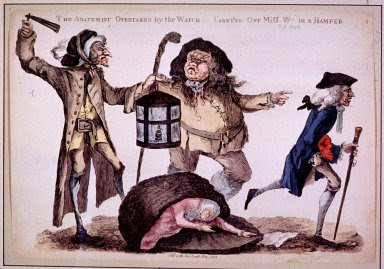
Hunter dissected every type of human or animal he could lay his hands on. His subjects included the famous Irish Giant, Charles Byrne or O'Brien, pictured at the top of the post in a print by Thomas Rowlandson from 1785. 

Hunter acquired the giant's body against the deceased's wishes by bribing the man who had it, allegedly for the then enormous sum of 500 pounds. Hilary Mantel wrote a novel about Hunter's pursuit of the Irishman's corpse, The Giant, O'Brien (1998).

In the painting of Hunter below, one can see part of the giant's skeleton, at top right. The painting today is on display at St. George's Hospital in Tooting. Hunter was chief surgeon at St. George's when it was located near Hyde Park. Today the hospital boasts one of the top cardiology units in the UK. I had the good fortune to benefit from it a couple of years ago. 

Ironically, Hunter himself died of a heart attack in 1793. It happened during a heated argument with the governors of St. George's Hospital. It may have been a burst aneurysm. 


Animals of all kinds, lower as well as higher, went under John Hunter's dissecting knives. He maintained a large menagerie at his suburban house at Earl's Court, including kangaroos, giraffes, and leopards. [Images: Hunter's house at Earl's Court.]


Hunter's huge anatomical collection, or what survives of it, now resides in the Hunterian Museum, at the Royal College of Surgeons, Lincoln's Inn Fields. Among the exhibits is the skeleton of the Irish Giant. It's fascinating stuff, but definitely not for the squeamish. [Image 1: Part of the Hunterian Collection Image 2: The skeleton of the giant]


In 1771, Hunter married Anne Home, a poet who wrote the lyrics to 14 of Franz Joseph Haydn's English songs. She and Haydn met after her husband's death. They became close friends. How close is a matter of speculation. 

Hunter left Anne in straitened financial circumstances. In 1799, she sold her husband's anatomical collection to the government for the then huge sum of £15,000. The government gave the collection to the Royal College of Surgeons. 

In 1776, Hunter became surgeon to King George III. In 1790, Prime Minister William Pitt appointed Hunter Surgeon General of the British Army. In the latter post he instituted reforms to insure that surgeons were recruited on the basis of ability rather than family connections.

Further Reading:

Wendy Moore, The Knife Man (London: Penguin, 2006)

Druin Burch, Digging up the Dead  (London: Vintage, 2008)

If you enjoyed this post and would like to become a follower of my blog, just click on the blue "FOLLOW" button on the right side of the first page. Below there you can also find my previous posts. Thanks! 


Thursday, 15 June 2023

Anatomy and Body Snatching in Georgian Britain: William Hunter


London's Soho district has long been notorious as a place where bodies are for sale. Living bodies. Less well known is its connection to the sale of dead bodies. If you walk along Shaftesbury Ave. to the Lyric Theatre, and turn onto Great Windmill Street, you will find this blue plaque on the side wall of the theatre:  


William Hunter (1718-1783), who once lived and worked here, was one of the most renowned (and often reviled) anatomists of the 18th century. He was born in Lanarkshire, Scotland. He studied medicine at Edinburgh University under William Cullen, then moved to London to train in anatomy and obstetrics at St. George's Hospital under William Smellie. Dissecting decaying bodies was indeed a smelly business, but the name was merely coincidental.  (Image: William Hunter, by Allan Ramsay)


Like all anatomists, Hunter needed dead bodies -- for his own research and for teaching anatomy. The number of legally available bodies, then restricted mainly to persons executed for murder, fell far short of the growing need. The number of anatomy schools, especially in London, was increasing, and with it, the demand for fresh corpses. 

For Hunter, the difficulty of obtaining bodies was compounded by the fact that much of his research was in obstetrics. His most famous work, The Anatomy of the Human Gravid Uterus (1774) involved the dissection of a lot of recently deceased pregnant women. 


Few if any of these bodies could have been obtained through normal legal channels. Executed murderers were not numerous enough, and in any case, pregnant women were rarely executed. They did, however, sometimes commit suicide out of a sense of shame or desperation. 

Most anatomical "subjects" had to be illegally "snatched," often from recent burials, sometimes before burial. In the cartoon at the top of this post, an anatomist, almost certainly Hunter, is shown fleeing after a watchman (at left) has discovered him with a woman's body. 

In 2010, Don Shelton argued that some of the women whose bodies Hunter acquired must have been murdered. Cases of people killing to acquire bodies to sell did occur, most famously that of Burke and Hare in Edinburgh in the 1820s, but there is no evidence that Hunter obtained corpses in this way.  

Anatomists and their students sometimes did body snatching themselves, but gangs of "resurrectionists" or "sack 'em up men" increasingly took over that task during the late 18th century. They took bodies from cemeteries, poorhouses, hospital morgues, and probably just found some lying in the streets or floating in rivers. 

Hunter's anatomy school in Great Windmill Street was a mecca for aspiring surgeons and physicians. A certificate of attendance at his courses was highly valued. Many of the most famous surgeons and anatomists of the next generation trained with William Hunter, or his younger brother John. [Image: Certificate of Attendance at William Hunter's lectures.]


Artists were highly interested in Hunter's work. His friends included famous painters and sculptors. In the painting below by Johan Zoffany, Hunter is pictured at the Royal Academy of Arts, next to Sir Joshua Reynolds (holding his ear trumpet in his arm).


Hunter's work and the source of his research material aroused much suspicion and derision. Cartoonists of the day sometimes made him their subject. The top one here shows Hunter with the mangled bodies of his "resurrected" subjects. The bottom image, by Thomas Rowlandson, shows a scene at Hunter's school. A man, possibly Hunter, is looking at a list of prices for bodies, male, female, and infant.


Further Reading:

Wendy Moore, The Knife Man (London: Penguin, 2006)

Don C. Shelton, "The Emperor's New Clothes," Journal of the Royal Society of Medicine, 2010: 103: 46-50


If you enjoyed this post and would like to become a follower of my blog, just click on the blue "FOLLOW" button on the right side of the first page. Below there you can also find my previous posts. Thanks! 

Monday, 9 May 2022

Canaletto Does London, 1746-1755


Giovanni Antonio Canal, or Canaletto, the handle he painted under, is renowned for his lavish portrayals of Venice, where he was born and spent most of his life. Even his name evokes the watery avenues of his native city. 

Canaletto is far less known for his "English Period." He spent nine years in London, arriving in 1746, and painted more than 50 London scenes. Many of them, like his Venetian paintings, focus on water, in this case the mighty Thames. 

He painted several scenes of the river from the terrace of Old Somerset House, the palace of the Somerset dukes. Here are three views from the house. The first two look east towards the City of London and St. Paul's Cathedral. The third looks west towards the seat of government at Westminster and its famous abbey. 


Another Thames vantage point Canaletto painted from was the first Westminster Bridge, which was under construction when he arrived in England. The bucket hanging from the arch provides a nice touch.


He also pained the whole bridge when it was completed in 1750. The painting here features the grand opening celebration, with the barges of the dignitaries. 


To the East of London, he did several paintings of Christopher Wren's Royal Naval Hospital at Greenwich, constructed between 1696 and 1712. The buildings later served as the Royal Naval College, and are now part of the University of Greenwich. The Painted Hall has recently been restored and is a must see. James Thornhill's masterpiece, it took nineteen years to complete.  


Canaletto did more than water scenes. Here is his stunning painting of Westminster Abbey, highlighting a procession of the knights of the Order of the Bath.


He left us a fine view of a former great aristocratic residence, Northumberland House, along with the equestrian statue of the ill-fated Charles I to its right. The statue remains where it was, but the house was demolished in the 19th century. The view here is looking up the Strand, the main thoroughfare connecting the City of London and Westminster. 


Another long-gone building he painted was the rotunda at Ranelagh Gardens, a great Georgian pleasure palace. The huge fireplace is at the centre. An orchestra plays at the right, while aristocrats and other wealthy folk promenade.


Canaletto painted several scenes of the famous Horse Guards. The first one here is the Old Horse Guards from St. James's Park, followed by the New Horse Guards that was constructed while he was in London and is still there.  


Below is a view of Whitehall, the seat of government, and the Privy Guards from Richmond House. 


Canaletto returned to Venice in 1755. He left behind a marvellous collection of scenes of Georgian London, then the largest city in the world. Of course, he completely ignored the world of the less fortunate, the crime, slums, and brutality that was the lot of many Londoners. His London is wealthy, even opulent, and the sky is always blue. 

Canaletto died in 1768 in his native city. Below is an engraving of the artist. 


Wednesday, 28 October 2020

Remember, Remember the Fifth of November: The Guy, Trump, and the Gunpowder Plot

November 5th, 2024 was America's Date with Destiny. Ironically, it coincided with the annual commemoration of the uncovering of the Gunpowder Plot in England in 1603. Had the plot succeeded it could have led to the overthrow of the government of James VI and I, the first monarch to rule the whole of the British Isles, and the deaths of the king, members of Parliament, and many others. The plotters were either executed or killed in a firefight. 

Remember, remember, the Fifth of November,

Gunpowder Treason and Plot. 

I know of no reason why Gunpowder Treason

Should ever be forgot. 

Guy Fawkes, Guy Fawkes, t'was his intent 

To blow up King and Parliament.

Three-score barrels of powder below

To prove Old England's overthrow;

By God's Providence he was catch'd

With a dark lantern and burning match.

And what should we do with him? Burn him!


[Image: The Discovery of the Gunpowder Plotters, as fancifully imagined by Henry Perronet Briggs, 1823]


The nursery rhyme above, or variants of it, has been part of British culture since the 17th century, as has the custom of Bonfire Night, or Guy Fawkes Night. On November 5, effigies of "The Guy" are burned in bonfires all over the UK. 

The Gunpowder Plot referred to was designed to blow up Parliament during its opening session on November 5, 1605, when the king and all the members were present. Fortunately for them, the barrels of gunpowder and Guy Fawkes were discovered in the cellars the evening before. Fawkes was an explosives expert and a Catholic who had been fighting for Spain and his faith against England and Protestantism.

The idea of burning "the Guy" in effigy is reflected in the rhyme's last line: "And what should we do with him? Burn him!" On the night the actual plot was foiled, the government ordered the lighting of bonfires to celebrate the King's (James I's) deliverance. It's not clear when or why burning the Guy first became a part of the celebration. At first, revelers burned effigies of the Pope. 

Burning "The Guy" eventually became a tradition in later years, though it's not clear why Fawkes was singled out. He was only one of fourteen conspirators led by Robert Catesby. Their goal was to destroy the Protestant ruling elite with one blow and restore Catholicism in Britain. 

[Below: A contemporary Dutch image of some of the Gunpowder Plotters. Fawkes is third from the right. He is named here as "Guido" Fawkes, the name he took when fighting for the Spanish.]


The real Guy Fawkes was not burned to death. He and several co-conspirators were hanged, then cut down and drawn (disembowelled) while still alive, and finally quartered. This was the traditional punishment for High Treason. Fawkes managed to avoid the worst part. He threw himself off the scaffold, breaking his neck. He was dead when they cut off his privates, removed his guts, and chopped his body in pieces. 

The reason for this horrific proceeding, other than sheer sadism, was to teach a political lesson. Various body parts were hung up about the kingdom to warn people with similar ideas of their possible fate. The other plotters were killed resisting arrest. 

In 1606, Parliament passed an act making November 5 a day of thanksgiving. The celebrations often led to attacks on Catholics. This was true in British North America as well into the 19th century. But with the influx of Catholic immigrants, Halloween gradually replaced Bonfire Night as an autumn celebration in the USA. 

In the UK the act establishing a day of thanksgiving was repealed in 1859 out of concern for Catholic sensibilities. But by then the lighting of bonfires on November 5 had become a firmly embedded tradition in most British communities. 

Bonfire Night gradually became more focused on general fun and a bit of mischief. During the late 19th century effigies of the Guy generally replaced ones of the Pope on the bonfires. Lewes in East Sussex continues to burn an effigy of Pope Paul V, who was pope in 1605. 

[Below: Guy Fawkes Night at Windsor Castle, 1776]


In many communities, children made The Guy, who was then processed to the place of "execution." The children would cry out "Penny for the Guy!" I recall doing it myself in Scotland as a child. I had no idea of the history of the tradition, and my mother was Catholic.  

[Below: Procession of a Guy, 1864].


[Below: Children with their Guys, Chirk, Wrexham, Wales, 1954]


Today Bonfire Night is a purely secular social event accompanied by fireworks and enjoyed by people of all religions and none. Few observers are likely to know the religious and political origins of the tradition.  

In a strange turn of events, many people now view Fawkes as a counter-culture hero for attacking the Establishment. Protestors often wear Guy Fawkes masks. "Guy Fawkes was the only man who ever entered Parliament with honest intentions" is a common saying nowadays.

Those who romanticize Fawkes should be aware that had the 36 barrels (2500 tons) of gunpowder under Parliament been detonated it would have destroyed everything up to 500 meters from the center of the explosion, killing hundreds of people. 


If you enjoyed this post and would like to become a follower of my blog, just click on the blue "FOLLOW" button on the right side of the first page. Below there you can also find my previous posts. Thanks!


Monday, 31 August 2020

The Peasants Strike Back

The people had had enough. Endless war, a deadly pandemic, and stagnant wages had pushed them to the edge of revolt. The actions of a selfish oligarchy took them over it. I could be writing about the present time in many places, but the events in question took place in 14th century England.

England had been at war with France almost continuously since King Edward III laid claim to the French throne in the 1330s. Historians call the conflict the Hundred Years War, though no one called it that at the time, obviously. 

The fighting had favoured the English in the early going. They won several lopsided victories, notably at Crecy in 1346 and at Poitiers ten years later. In a treaty of 1360, they gained control of large parts of France. In the 1370s, however, the war resumed, and the French won back what they had lost and more. (Image: Battle of Crecy, 1346. From the Chronicles of Jean Froissart)


In 1376 England's greatest warrior, Edward the Black Prince, died of a lingering disease. He was also heir to the English throne. His father Edward III died the following year. The crown passed to his son, ten-year-old Richard II. During the next few years, actual power was in the hands of councils dominated by overmighty nobles, including Richard's uncles. (Image: Richard II, portrait in Westminster Abbey, 1390s)


In order to pay for the French war, the government raised taxes. It introduced a new tax, a regressive poll tax. Attempts to collect the tax in May 1381 triggered a massive popular uprising. The causes of the revolt go far beyond hatred of the particular tax, however. Unrest and tension had been growing for decades. At its heart was the response of the ruling classes to the effects of the plague pandemic later known as the Black Death.

The plague arrived in England in 1348, having made its way along trade routes from the Far East. By 1349 it had killed between 40 and 60 per cent of the population. Plague returned in 1361, killing off another 20 per cent or so. One effect of this massive mortality was a severe shortage of labour. Peasants and other workers saw an opportunity to improve their condition. They demanded higher wages and an end to serfdom and other injustices.

The landed classes, the lords and gentry who dominated Parliament, responded with the Statute of Labourers (1351). It essentially froze wages at their pre-plague levels. Although not entirely successful, it worked well enough to arouse widespread anger at the government and the aristocrats that controlled it. The sense of injustice contributed to the popularity of egalitarian ideologies.

The revolt broke out in Essex on May 30 with an attack on tax collectors. It spread quickly to Kent and much of the Southeast. The rebels, who included artisans and local officials, burned court records and emptied the jails. Thousands of Kentish rebels marched on nearby London, led by Wat Tyler and a radical priest, John Ball, whom the rebels had released from prison.

At Blackheath, near London, Ball famously exhorted the rebels to fight for equality. "When Adam delved and Eve span, who was then the gentleman?" he asked. "From the beginning all men were by nature created alike, and our bondage or servitude came in by the unjust oppression of evil men ... now the time is come, appointed to us by God, in which ye may ... cast off the yoke of bondage, and recover liberty." (Image: John Ball encouraging the rebels; Wat Tyler is in red at front left. Chronicles of Jean Froissart)


On June 13, sympathetic citizens admitted them into the capital. Together, they destroyed the Savoy Palace, residence of the king's hated uncle John of Gaunt, Duke of Lancaster. They attacked the jails, burned buildings, and killed a number of government officials, including the Lord Chancellor and Lord High Treasurer. Richard II fled to the safety of the Tower of London.

On the 14th, Richard met the rebels' representatives at Mile End and granted most of their demands, including the abolition of serfdom. On the following day he met them again. On this occasion, a confused melee broke out, and a member of the king's party killed Wat Tyler. (Image: The Death of Wat Tyler, Chronicles of Jean Froissart)


In the confusion that followed, Richard managed to calm the rebels and assure them he was on their side. "I am your captain, follow me," he is alleged to have said, and led them away from the scene. Meanwhile, the Lord Mayor of London rallied a militia and confronted the rebel forces. Richard urged them to disperse to their homes, which most did.

The rebellion continued in other locales, but the king's supporters suppressed it during the next few weeks and months. Richard rescinded his promises for change, including the abolition of serfdom. Most of the rebel leaders were hunted down and executed, along with about 1500 others.

The Great Revolt, or Peasants' Revolt, as it is more conventionally known, failed to win the rebels' immediate demands. Yet, the fright it gave to the ruling orders did help bring change. The poll tax was abandoned. Nothing like it was imposed again until the premiership of Margaret Thatcher (1979-1990), who forgot the lesson of 1381. It aroused mass protests
, first in Scotland, then in England. It was replaced in 1993 by the Council Tax.

Subsequent Parliaments were reluctant to raise taxes, making it difficult for the government to pay for campaigns in France. Serfdom was not abolished but it gradually died out over the next few decades, as landowners commuted labour services into money rents.

Wages also rose, in spite of the Statute of Labourers. Economic laws of supply and demand proved stronger than the laws of Parliament. Between 1350 and 1450 wages nearly doubled. The 15th century has sometimes been called the Golden Age of the English Peasant. Unfortunately, these gains were largely lost by population growth in the 16th century.

The Peasants' Revolt has continued to fascinate historians, writers, artists, and musicians into our own times. In 1888, the artist, writer, and designer William Morris published a novel about the Great Revolt, A Dream of John Ball. The work centres on Ball and his egalitarian ideology. Below is one of Morris's illustrations for the novel.


In many respects the situation of the UK today resembles that of 1381. The combination of disasters: Brexit, Covid pandemic, the Ukraine war, and an out of touch government has produced economic crises and widespread industrial unrest. Will it all lead to another mass revolt? We will see. 


Thursday, 18 June 2020

Moving the Dead: From Churchyards to Cemeteries

When we visit old churches in Europe and the Americas, say older than the mid-19th century, we expect to find graves in the churchyards and in the churches themselves, under the floors, in crypts, in the walls. The two medieval parish churches below are an example. The first is in Eyam, Derbyshire, the other in Beddington, South London.


In the Crypt Café in St. Martin in the Fields, London, you can walk and even dance to jazz on the graves of the dead. None of them have gotten up to join the fun, as far as I know. 


Modern churches seldom host the dead, or not very many. Instead, we find them in large cemeteries, usually well away from the old centers of towns and cities.

Why is this? In part, the shift occurred to the rapid growth of population, especially in urban areas. During the industrial revolution, urban populations grew exponentially. New cities mushroomed where once there were mere villages or small towns. Many old cities expanded enormously. London grew from about 600,000 in 1700 to over 4 million by 1900.      

Another development that promoted the change in burial practices was increasing acceptance of the miasma theory of disease. This was the idea that disease spread through bad air, or unpleasant smelling miasmas. 

The main source of miasmas was said to be decomposing organic matter. Swamp and marshes were a major source of bad air (Italian: mal'aria) and many doctors attributed fevers to the gases that arose from them. The bad air theory survives in our name for an ancient disease that remains a major killer, malaria. It is one of the quintessential "miasmatic" diseases. 

Miasmas were blamed for numerous other killer diseases, including typhoid, yellow fever, and one that terrorized 19th century cities: cholera. The color lithograph below, by Robert Seymour (1831), imagines cholera as a death-bearing ghostly cloud.


In the case of cholera and many other infectious diseases of urban areas, the major source of miasmas was believed to human and animal wastes. Disposal of organic wastes became a bigger problem as population densities grew. And they far faster than effective sanitary infrastructures. As historian Stephen Marcus wrote of 1840s Manchester, "people were literally living in shit." 

Miasma theory contributed to demands for urban sanitary reform. Although they knew nothing of the role of germs, advocates of the theory campaigned for the cleaning up of noxious streets and privies, removal of human wastes through sewage systems, and the provision of clean water to houses. 

They also targeted something else: churchyard burials. The growth of urban populations outstripped the burial space in the church cemeteries. As they became more crowded, churchyards overflowed with bodies whose decomposition often produced foul smells, especially during major epidemics. 

The solution, Miasmatists believed, was to ban church burials and create large, parklike cemeteries on the outskirts of towns, away from densely populated areas. The idea produced a lot of opposition from people who believed that burial near the church placed them closer to God. In the end, however, the sanitary reformers won the debate. For good or evil, cities relocated the dead and altered the urban environment in a significant way. 

Below are a few examples of early ex-urban cemeteries:

Highgate Cemetery, North London


Putney Vale Cemetery, Southwest London


Magnolia Cemetery, Charleston, South Carolina