Showing posts with label Joshua Reynolds. Show all posts

Thursday, 15 June 2023

Anatomy and Body Snatching in Georgian Britain: William Hunter


London's Soho district has long been notorious as a place where bodies are for sale. Living bodies. Less well known is its connection to the sale of dead bodies. If you walk along Shaftesbury Ave. to the Lyric Theatre, and turn onto Great Windmill Street, you will find this blue plaque on the side wall of the theatre:  


William Hunter (1718-1783), who once lived and worked here, was one of the most renowned (and often reviled) anatomists of the 18th century. He was born in Lanarkshire, Scotland. He studied medicine at Edinburgh University under William Cullen, then moved to London to train in anatomy and obstetrics at St. George's Hospital under William Smellie. Dissecting decaying bodies was indeed a smelly business, but the name was merely coincidental.  (Image: William Hunter, by Allan Ramsay)


Like all anatomists, Hunter needed dead bodies -- for his own research and for teaching anatomy. The number of legally available bodies, then restricted mainly to persons executed for murder, fell far short of the growing need. The number of anatomy schools, especially in London, was increasing, and with it, the demand for fresh corpses. 

For Hunter, the difficulty of obtaining bodies was compounded by the fact that much of his research was in obstetrics. His most famous work, The Anatomy of the Human Gravid Uterus (1774) involved the dissection of a lot of recently deceased pregnant women. 


Few if any of these bodies could have been obtained through normal legal channels. Executed murderers were not numerous enough, and in any case, pregnant women were rarely executed. They did, however, sometimes commit suicide out of a sense of shame or desperation. 

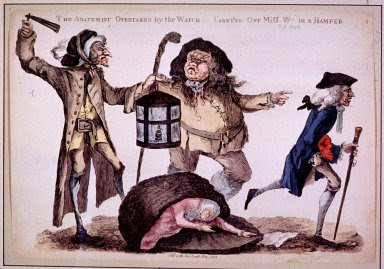
Most anatomical "subjects" had to be illegally "snatched," often from recent burials, sometimes before burial. In the cartoon at the top of this post, an anatomist, almost certainly Hunter, is shown fleeing after a watchman (at left) has discovered him with a woman's body. 

In 2010, Don Shelton argued that some of the women whose bodies Hunter acquired must have been murdered. Cases of people killing to acquire bodies to sell did occur, most famously that of Burke and Hare in Edinburgh in the 1820s, but there is no evidence that Hunter obtained corpses in this way.  

Anatomists and their students sometimes did body snatching themselves, but gangs of "resurrectionists" or "sack 'em up men" increasingly took over that task during the late 18th century. They took bodies from cemeteries, poorhouses, hospital morgues, and probably just found some lying in the streets or floating in rivers. 

Hunter's anatomy school in Great Windmill Street was a mecca for aspiring surgeons and physicians. A certificate of attendance at his courses was highly valued. Many of the most famous surgeons and anatomists of the next generation trained with William Hunter, or his younger brother John. [Image: Certificate of Attendance at William Hunter's lectures.]


Artists were highly interested in Hunter's work. His friends included famous painters and sculptors. In the painting below by Johan Zoffany, Hunter is pictured at the Royal Academy of Arts, next to Sir Joshua Reynolds (holding his ear trumpet in his arm).


Hunter's work and the source of his research material aroused much suspicion and derision. Cartoonists of the day sometimes made him their subject. The top one here shows Hunter with the mangled bodies of his "resurrected" subjects. The bottom image, by Thomas Rowlandson, shows a scene at Hunter's school. A man, possibly Hunter, is looking at a list of prices for bodies, male, female, and infant.


Further Reading:

Wendy Moore, The Knife Man (London: Penguin, 2006)

Don C. Shelton, "The Emperor's New Clothes," Journal of the Royal Society of Medicine, 2010: 103: 46-50


If you enjoyed this post and would like to become a follower of my blog, just click on the blue "FOLLOW" button on the right side of the first page. Below there you can also find my previous posts. Thanks! 

Sunday, 7 April 2019

Francis Barber: the Slave who became Samuel Johnson's Heir

Samuel Johnson  (1709-1784), often referred to as Dr. Johnson, is best known for his Dictionary of the English Language (1755), and the classic biography of him by his friend James Boswell, The Life of Dr. Johnson. (Below: Portrait of Johnson by Joshua Reynolds)


Among Johnson's many other writings is a long essay, Taxation No Tyranny: An Answer to the Resolutions and Address of the American Congress  (1775). As the title indicates, Johnson rejects the American colonists' complaint that they were being oppressed by taxes levied by the British parliament. 

Among other things, Johnson argued that the Americans' claim that there should be "No Taxation without Representation" was unfounded. The colonists had voluntarily resigned the power of voting in British elections by leaving Britain, but retained "virtual representation" in Parliament, as did British people who had no right to vote. If the colonists wanted to take part in British politics, he suggested, they could move to England and buy an estate. 

This argument was unconvincing then and hasn't improved with time. Taxation No Tyranny has contributed to the common view of Johnson as an arch Tory. In some respects he was, but the reality is more complicated, and far more interesting. Another of Johnson's arguments is far more powerful -- and liberal. It may be summed up in the line "How is it that we hear the loudest yelps for liberty among the drivers of negroes?" 

Here Johnson hit the colonial argument for liberty at its most vulnerable point. The colonists claimed that the British government was trying to enslave them while holding hundreds of thousands of people in the most oppressive form of bondage. 

Johnson, unlike most influential Britons in the 1770s, considered slavery an abomination. He once proposed a toast to "the next rebellion of the negroes in the West Indies." He also argued that if the Africans were freed and given some land, they would likely prove better citizens than their masters.

Johnson did more than talk the talk. Years before he essentially adopted a former Jamaican slave, Francis Barber, and educated him. Barber entered Johnson's household as a boy in 1752. Johnson's wife Elizabeth had just died, plunging Johnson into a deep depression. Barber's owner sent Barber to serve as Johnson's valet. 

Barber  (1742/3-1801), originally named Quashey, was still a slave at that time, but his owner freed him two years later. After gaining his freedom, he worked for an apothecary, briefly as a sailor in the Navy, and then as Johnson's assistant. Barber married Elizabeth Ball, a white woman with whom he had two children. In his will, Johnson left Barber a substantial legacy in money along with his books and papers, and a gold watch. 


The portrait above, which some art experts attribute to Johnson's friend Joshua Reynolds, hangs in Johnson's house today. Whether it is a portrait of Barber or not is disputed. Some experts think it is a portrait of Reynolds' manservant. 

Johnson's house, just off Fleet Street in Gough Square, is open to the public daily. It is well worth visiting to learn more about Johnson and Barber.


Further Reading: Michael Bundock, The Fortunes of Francis Barber: The True Story of the Jamaican Slave who Became Samuel Johnson's Heir (New Haven and London: Yale University Press, 2015)