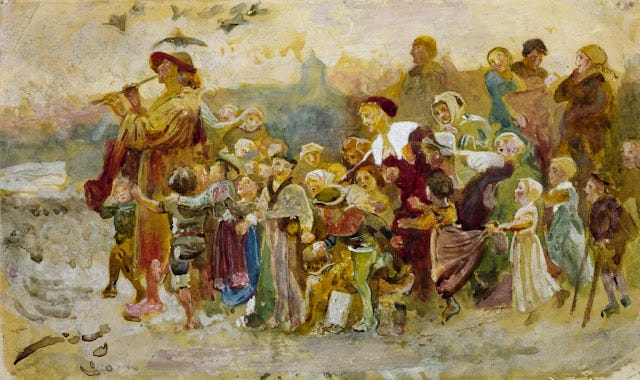
Shamelin was once the richest, most powerful, most envied country on the planet Zed. Yet, somehow many of the Shamelians were discontented. The grossly rich, because they never felt rich enough. The poor, because they were poor. For some odd reason, many of the poor did not blame the grossly rich. They blamed immigrants, foreigners, "libruls," "lefties," "commies," and other rats, as they called them. "We are temporarily embarrassed millionaires, and we are patriots," they said with pride. "We just need to get rid of the infestation of rats in this country, and all will be well."
"We need new leadership," the malcontents said, urged on by FUX News. "Someone who will make Shamelin Great Again. The last Leader wasn't a true Shamelian. He sure didn't look like one of us." The cry went up from the voices of millions of Shamelians "Make US Great Again! MUGA! MUGA! MUGA!" They had hardly ejaculated this chant when a voice boomed out to them from the sky. Or so it seemed. It actually came from their TVs, amplified daily by the MSM, especially FUX.
"I am a famous TV star. You know me as The Boss. I'm also the world's greatest real estate developer. I'm so good at what I do I've gone bankrupt many times. How many people can say that? I will save Shamelin from its enemies within and without. I will get rid of the rats plaguing this country. Make it great again. Make me The Leader and there will be bigly changes. The best bigly changes. I will build a wall! A bigly wall. The best wall. To keep out the bad people. Bad people. Rapists, drug dealers, killers. Sad. The best things will happen to the economy. It will be so good you can dress in dollars."
The Shamelians cheered. They felt a sudden surge of pride in his words, despite the weird orange glow of his face. No one had spoken to them with such brilliance in decades, if ever. The Boss is our man, they thought, and we have made him possible. Because we love our country. They cried out as one: "How can we help you, Boss?" "Vote for me in the next election for The Leader. The Dumocrats think they have it locked up. But I have a secret weapon. Friends in very high places. Bigly places. The bigliest places." "Who are those friends in high places?" asked one slightly skeptical Shamelian. “Give us some evidence!” The people around the questioner grabbed and beat him, and told him to shut up. "I can't tell you who,” the Boss said, snarling. “It's a secret. But they love you and want to save you from the evil Dumocrats, and they know I’m a genius who can do anything. Now, if you want me to save you, you must love me. I can't stand to be unloved. Sad! Vote for me and you will never have to vote again!"
Voting day came, and the results were close. The Dumocrat candidate for Leader got more votes than the Boss. But Shamelin had a strange clause in its constitution, which allowed the loser to win. Forgive me for not explaining it. Only three people have ever understood it. One is dead, the second went mad. I'm the third, and I forgot. This is how The Boss became The Leader, along with help from the unknown people in high places. He started off his Leadership by engaging in his favorite task: firing people. Not only people from previous Leaders' administrations. He even fired his own people after a while, people he said were the best people when he hired them. He said they did not love him enough, did not appreciate his genius, or were too lazy. He hired replacements who, he said, were even better.
He soon made it clear who was Boss and Leader on Zed. He told other countries that Shamelin was number one and should get all the best stuff. A few other countries had some good points, if they were trying to be like Shamelin, but they were sad places compared to number one. A lot of them, he said, were shithole countries. His supporters cheered these statesmanlike words. He insulted Shamelin's allies and refused to cooperate with them to protect Zed’s environment. To show who was Boss, he got rid of environmental protections. "We have lots of bottled water for sale. And a little polluted water won't hurt you," he said. "It strengthens your immune system. And smoke is good for the lungs. Makes you tough, like me."
He told the leaders of other countries that he would destroy them if they didn't do exactly what he said. When they didn't do as he said, he said he loved them and wanted to be best pals. His supporters loved everything he said, because he said it. He could say one thing one day and the opposite the next. They cheered it all. They would deny he ever lied or contradicted himself. He claimed he was the most honest Leader Shamelin had ever had. And he knew more than anybody, on any subject. He was, as he so often said, a stable genius. His MUGATs drank it all in, like Kool Aid.
He was so brilliant, so perfect in every way, that some of his most enthusiastic supporters claimed he had been sent by God to save Shamelin, God's favorite country. Why it needed saving if it was God’s favorite country was a question they never asked. The Boss agreed with all this and began to do something new: he prayed, or made others pray for him. One day he proclaimed that he had done more for the true faith than God himself. He sold Bibles, printed in Orientia, a rival of Shamelin’s, at a considerable markup. They sold out. Religion is good business, he concluded.
Things went along swimmingly like this for about three years. About that time, Orientia reported the outbreak of a new epidemic disease. It was killing many people, mostly old. The major symptom was laughing, which ranged from a mild Ha! Ha! to a ceaseless, hysterical guffawing. When a patient cried out, "I'm going to die laughing," the doctors knew it was all over. The Leaders' medical advisors warned him about the new disease. "It's so far away. It'll never get here." They told him it was caused by a virus that could spread far and fast. "What's a virus?" he asked. When they told him, he laughed. "Nothing that small could hurt a person, unless they were small, too. Like the Orientians. Nothing to worry about." Unfortunately, the virus did not heed the Leader's words. It spread to many countries on Zed. Within a few weeks, it had arrived in Shamelin. The Leader laughed it off. "It's a hoax. Just a common garden variety bug. We might have a handful of cases, all mild, and then poof, it will be gone. It might kill a few old, useless persons, but nobody will miss them leeches. I know more about this virus than anyone. The doctors are amazed by my knowledge."
Once again, the brainless virus outwitted the great genius. The number of cases mounted, slowly at first, then more rapidly. They included people of all ages, not only the old. The Leader blamed his political opponents. He blamed other countries, especially the Orientians. He blamed the media. "Bad reporters," he said. He blamed his medical advisors. "They're Chicken Littles. Always crying about the sky falling." When things got worse, he complained that "No one warned me about this," he said. "It caught me by surprise." He said the whole virus thing was an underground plot to make him look bad. "They want to spoil my chances to get re-elected and become Leader for Life." As the virus spread, The Leader’s utter lack of preparation quickly became obvious. Those fighting the epidemic lacked the protective equipment, the testing kits, and the technology to do their job. The Leader insisted that these things could be had in plenty if health care workers weren't stealing them. When the governors of Shamelin's hardest hit states asked The Leader for help, he told them they didn't love him enough to deserve it. He told them to help themselves. "I have absolute authority, of course. But the responsibility for this is yours."
One day, The Leader told an astounded country, "This virus is really dangerous. It could kill a lot of people. If we can keep the number of dead under 200 million that would be a victory. And that victory will be my doing!" Hearing this, the Shamelians -- well, about half of them -- cheered wildly. The rest put their hands to their faces in disbelief, even though they knew that could spread the virus, which was killing people all around them. Things, as you can imagine, got worse, much worse. Shamelin had more deaths than any other country on Zed. But the Leader smiled and told Shamelians that the best was yet to come.
TBC